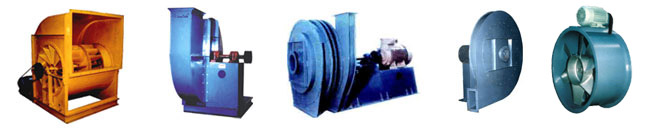
Supply of Canada Blower heavy duty
fans and blowers, centrifugal roof and wall fans, industrial process
ventilators, centrifugal OEM fans,
combustion blowers and furnace fans. Sales of dust collector fans,
dryer ventilators, high temperature oven fans, industrial central
vacuum blowers, OEM high pressure fans, as well as commercial
centrifugal wall and roof fan ventilators.
OLEG BLOWER COMPANY
|
|
|
|
|

|
| |
 |
Centrifugal
Wall or Roof Mount Ventilators |
|
|
|
|
|
|
|
Canada Blower is an engineering
representative and developer of various types of gas-fired air makeup
units for
industrial building ventilation.
Gas-Fired NISCO
Canada Blower Pressurization Units move
large quantities of air at low temperature differentials (usually
50° or less),
which is a strategy to minimize temperature stratification in the large
spaces
they are employed to heat. The equipment is typically mounted on the
roof of
the facility or at grade on elevated supports to ensure that the supply
air is
delivered high. The high air delivery allows for a longer “throw” of
the air,
thereby requiring less equipment to cover the required floor area. The
most
common fuel is natural gas, however, units can be converted to burn
propane.
There are two primary categories of gas-fired AHUs: indirect-fired and
direct-fired.
Canada Blower
Indirect-fired units burn the fuel and air
mixture inside of a heat exchanger while the air traveling to the space
passes
over the outside of the heat exchanger. In this design, the products of
combustion travel through a vent to the outside of the building.
Canada Blower
Direct-fired units utilize air that will be
sent to the heated space for combustion without use of a heat
exchanger. The
products of combustion are mixed directly with large volumes of outdoor
air.
Such mixing is considered safe because of the high dilution ratio.
In addition,
thorough burning of the natural gas takes place
so that no harmful products of combustion enter the airstream. One
product of
combustion is water vapor, which can be problematic with very tight
building
construction due to the potential for condensation in colder climates.
For
tight buildings, it is best to consider the use of indirect-fired
equipment.
There are several common configurations of direct-fired units.
The 80/20
design can vary the quantity of outside air from
100% down to 20%. The burner has a high turndown ratio and only outside
air
should be drawn across the burner. The discharge air volume is fixed
and the
quantity of outside air can be adjusted to maintain building
pressurization.
The makeup air unit configuration is ideal for supplying large
quantities of
replacement air for facility exhaust systems. Such systems can include
paint
spray booths and other industrial exhaust applications. These units
supply a
fixed amount of 100% outside air. Air Recirculation units recirculate a
fixed
80% of the air while bringing in 20% outside air that passes over the
burner.
They supply a minimum amount of ventilation to spaces that do not
require large
quantities of outside air to maintain building pressurization.
Variable Air
Volume VAV units have a varying supply air
volume and work similar to the 80/20 design, however, the recirculated
air
passes through a bypass section instead of through the facility. This
type of
unit is used in applications where building pressurization is desired
and where
contaminants located in the space cannot be recirculated.
Facilities that
have indoor vehicle operation frequently
accumulate carbon monoxide and associated noxious fumes. For such
instances, a
ventilation sequence can be instituted to limit this potentially
harmful
buildup. The pressurization units for these buildings could be fitted
with a
carbon monoxide detector with an initial setpoint of, for example, 50
ppm that
would trigger an alarm and energize a time-delay relay.
If the
condition still exists after, say, five minutes, then
the return air damper would modulate closed and the outside air damper
would
modulate to the 100% open position. A second setpoint of 100 ppm would
initiate
an alarm and eventually de-energize the burner. The dampers would then
be
positioned to enable the exhaust mode. After the carbon monoxide
returns to a
safe level, the sensor could reset the unit to normal operation.
In addition to
emergency ventilation to purge carbon
monoxide, the pressurization unit can be used to provide a source of
ventilation during warm and hot months of the year. A reverse acting
thermostat
would modulate the outside air and return air dampers to bring in more
outside
air to maintain the indoor setpoint. These units can also be fitted
with either
chilled water or DX cooling coils to provide tempered or conditioned
air to the
space during the summer.
Direct-fired
pressurization units are approximately 93%
efficient, with much of the available energy in the burned natural gas
being
delivered to the space in the form of heat. The supply airstream
absorbs the
heat that would be normally lost through a flue or vent pipe as in the
indirect-fired configuration.
A feature of
this type of equipment that is especially
important in cold climates is its ability to keep the building slightly
pressurized to typically at 0.01 in. wc. This reduces the infiltration
of cold
air, and when overhead doors are opened, the outside air dampers are
modulated
open to admit more air to maintain this level of pressurization. This
feature
also acts as virtual ductwork to distribute air where it needs to go:
toward
cracks or areas with open doors.
Direct-fired
pressurization Canada Blower AHUs is capable of
delivering plenty of ventilation to a facility when it is configured as
the
80/20 system described previously. Infrared systems, however, may need
to be
supplemented with a separate ventilation system. With certain classes
of
facilities, the infrared system would not require additional equipment
for
ventilation, since large structures with many doors would provide
enough
natural ventilation through leakage.
Gas-fired
pressurization systems each offer good solutions
to heating large structures such as warehouses, distribution centers,
aircraft
hangers, and manufacturing facilities. Situations that require
significant
ventilation favor pressurization air handlers as do facilities that
generate
dust, mists, and other contaminants. Cleaner environments with less
intensive
ventilation needs would do well to go with the infrared radiant heating
approach. In very cold climates, it might be beneficial to go with a
hybrid
solution using radiant heat at the perimeter as the primary heating
source and
placing pressurization units at the center of the facility for
ventilation and
for pressurization when doors are open.
Additional
information can be found at the NISCO web site






 Wall mounted
centrifugal ventilators are
used where it is impractical to install the ventilators of the roof.
These
fans are either exhaust or air supply power ventilators.
